It's hard to put into words what finishing my first Ironman 70.3 means to me. While the race itself lasted over eight hours, the journey stretched across two years. Looking back, I realize it wasn't one big decision that got me here. It was a series of small nudges that eventually convinced me to try something I never thought I'd do. I hope my story inspires others to lean toward the edge of their comfort zone and see what they may find.
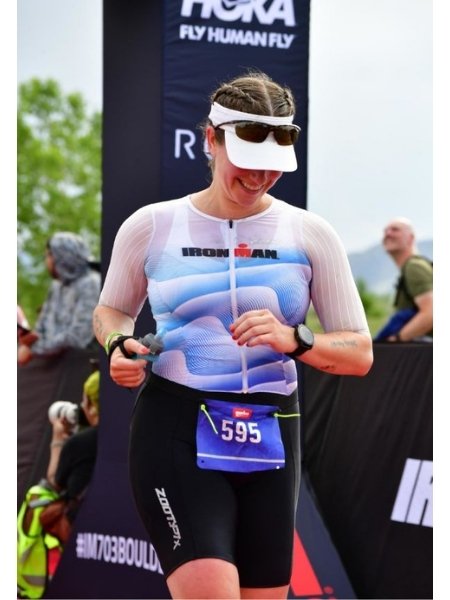
From zero triathlon experience to becoming an Ironman 70.3 in nine months. Below is the story of what happened along the way.
THE BACKGROUND
A year and a half before clicking the registration button, I developed a stress fracture in my heel. Recovery was painfully slow. I spent months alternating between walking in a boot, resting, and trying to stay active without worstening the injury.
After visiting seven doctors, podiatrists, and PT’s, I still wasn't getting answers. I'd rest, improve slightly, return to activity, and the pain would come back. I bought a bike because it was one of the few ways I could exercise without fully aggravating my foot. Somewhere during those long bike rides, I remember joking, "… if I learned to swim, I guess I'd have everything I need for a triathlon."
At the time, it felt like nothing more than a joke. But not long afterward, another unlikely influence entered the story.
After a gyno dismissed my bloodwork, an amazing hematologist confirmed I had anemia. My ferritin was 14 and I craved meat like a wild woman. Iron infusions began immediately. During that time I found out that my hematologist was a retired Ironman who competed at the Ironman World Championship in Kona.
I still wasn't thinking seriously about racing an Ironman. But then came another unexpected nudge.
About a year before race day, I was hired to help an 84-year-old client move her home. I spent days directing the packing and relocating her entire household. Meanwhile, she calmly steered clear of the chaos by going to her backyard pool in the afternoon to swim laps. She wasn't just an active retiree. She’d completed 4 full Ironmans and had been one of the first women to compete in marathons decades earlier.
She carried herself with unwavering confidence and a sassy sense of humor. While everyone else rushed, she was completely steady. She's someone I genuinely admire and now call a friend.
Eventually enough tiny moments lined up that I finally stopped wondering if I could do an Ironman and just clicked "Register."
There was just one small problem… I didn't actually know how to be a triathlete.
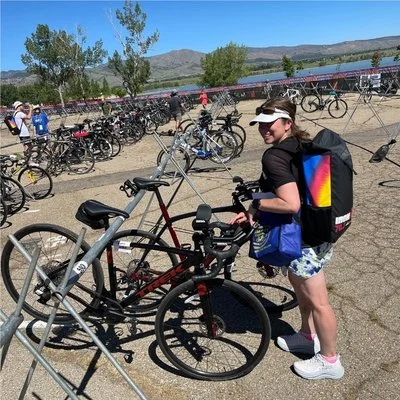
A bundle of nerves at bike check-in. Handing over my bike before the race made everything feel VERY real.
THE TRAINING & OBSTACLES
Going from zero to half Ironman is basically one long series of learning curves. Forget racing - I couldn't even clip into my bike pedals. I hadn't swam competitively in 25 years, and I'd never swam in open water. Every week introduced something new: learning nutrition while riding, learning new gear, learning not to panic in open water, learning to sight in open water, learning how to balance hours of training with my business and everyday life. Just when I felt comfortable with one skill, another challenge appeared. For months progress didn't feel like getting faster; it felt like becoming a little less clueless each week.
WHY IRONMAN?
I actually didn’t care too much about becoming a triathlete. What I really wanted was to find out if I could be disciplined enough to train consistently, even when I wasn't very good. As an experienced mountain climber, I thought Ironman would feel similar. I was very wrong.
A mountain gives you immediate feedback. You suffer (a lot) for a day or so, celebrate the summit, and head home with a big sense of accomplishment. For me, mountains have been about handling one or two incredibly hard days. Ironman, however, asked me to endure hundreds of ordinary ones. With Ironman training there are no weekly summits - just hundreds of ordinary workouts, constant recovery, nutrition planning, technical skills to learn, and fatigue that becomes part of your daily routine. Most days, I wasn't particularly good at swimming, cycling, or running. In fact, I was pretty bad at all three. But that wasn't the point. The point was to show up, no matter what, over and over again.
I was lucky not to do it alone. During those same months, my partner Sam was training for his first 50-mile ultramarathon. We spent countless mornings and weekends following separate training plans side by side. Watching his quiet consistent discipline inspired me more than he'll probably ever realize. On the days I wanted to skip a workout, watching him show up anyway made it a little easier for me to do the same.
That was the biggest lesson of my entire experience. Ironman training teaches you to find meaning in the process long before race day. You have to be willing to spend months doing a lot of things mediocrely with little payoff - and sometimes negative payoff. I started training hoping to build discipline. By the end, I gained so much more.
THE HARDEST PART WASN’T THE WORKOUTS
Ironman training isn’t just endless swimming, biking, and running. For me, the bigger challenge was everything happening outside the workouts.
Like self-doubt. Doubt wasn't something I got over all at once. It showed up every time a new obstacle did. With every new skill came the opportunity to question whether I belonged in the sport at all.
The first few months were especially tough mentally. Learning three sports at once felt overwhelming, and I carried serious anxiety about the swim. I was nervous about pool workouts and feared open water even more. Eventually, Sam paddleboarded alongside me while I learned to trust myself in open water.
I learned that endurance sports depend just as much on what happens outside the workouts as what happens during them. Protecting my sleep, boundaries around business, recovering well, and taking care of my mental health was just as important as completing another workout off the training plan.
My body was also dealing with challenges that had nothing to do with triathlon. While I continued treatment for anemia, timing iron infusions around recovery days, I was also monitoring endometriosis through ultrasounds. Throughout training I experienced bouts of week-long nausea. It wasn't until my pre-race ultrasound that we realized what had been happening. My usual count of 5 endometriomas had dropped to 2, meaning several cysts had slowly ruptured while I continued to work, train, and live as if nothing unusual was happening.
And then there was the thing I didn't expect at all: my body changed.
Over 9 months of training, I got bigger. For someone spending hours exercising every week, it felt completely backwards. But it's more common than people think. Between the physical stress and learning how to properly fuel endurance workouts, bodies often respond in unexpected ways. It was one of the harder mental adjustments of the entire journey. I had to learn to value what my body was capable of rather than how it looked.
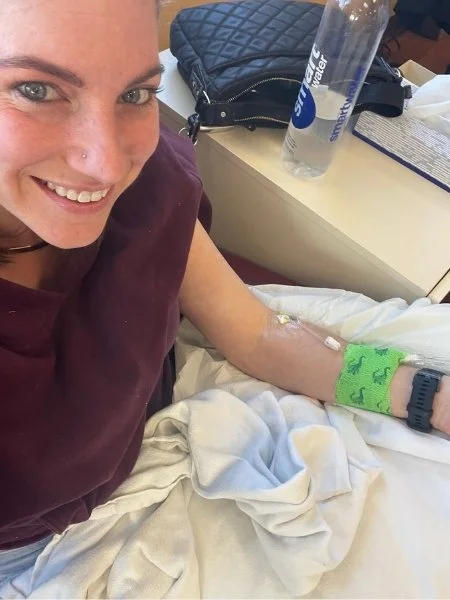
Trying to calm anxiety during one of my seven iron infusions.
THE RACE
I felt sick. Approaching the corral, I had two very public dry-heaving sessions. Getting to the swim start was easily one of the scariest moments of my life. I held hands with a couple friends as we slowly shuffled toward the water. We were shaking. Every five seconds, another BEEP sent four more athletes disappearing into the Boulder Reservoir. 2,000 people funneled into the murky water, one beep at a time. It felt like the longest walk of my life.
BEEP!!
WE. WERE. OFF. Instant flailing arms and legs and inhaling chop as a mass of bodies panic during the first 100 meters. It was pure chaos.
By 200 meters I was convinced I had made a mistake. This was crazy. As it turns out, I wasn't the only one. More than 60 athletes never made it beyond the swim to complete the race.
At the 300 meter mark, I made a deal with myself. I wouldn’t touch a safety kayak or grab for a buoy. I knew if I stopped, even for a second, I'd convince myself not to continue. With each exhale I started yelling mantras under water. It was time to be maniacally intense.
Stroke.
"Next Buoy!"
Stroke.
"Focus!"
Stroke.
“GO!!!”
I swam like my life depended on it. It was both dramatic and hilarious. At one point I had to swim around a cluster of men who were moving slower than I was, only to get cut off by a woman leisurely doing the backstroke in the complete wrong direction. Finally seeing the swim exit was, without question, my proudest moment of the entire race. And there were still two sports left to go.
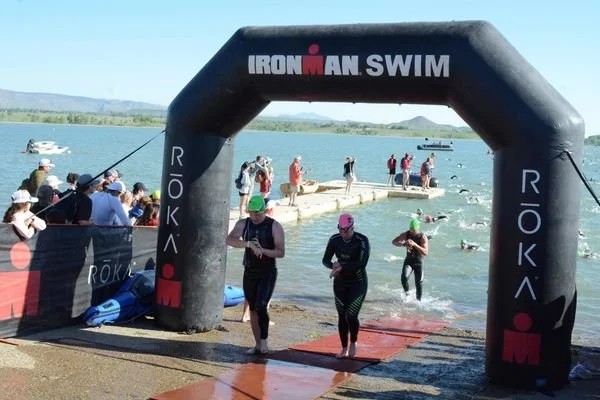
Out of the resevior and into transtition. Exiting the swim was the most relieving part of the race.
When I entered T1 (first transition area), more than half the bikes were still racked, which meant I was doing well. I headed out feeling optimistic and immediately started biking up the hills Boulder 70.3 is known for.
Six miles later, my chain came off. I stood on the side of the road watching hundreds of cyclists pass while I waited for help that never came. After several minutes, a nearby photographer casually mentioned that I could simply put it back on myself. Awesome. Lesson learned.
I got back on the bike and began the steepest part of the course cautiously, scared my chain would come off again on a descent. Seeing my cousin Nancy cheering like crazy along the bike course helped me hold it together.
From there, the day became a game of problem-solving. I struggled to fuel while riding, and my nutrition was too concentrated compared to my hydration. By mile 44, I was battling nausea and GI issues that made every mile feel harder than the last.
Just as my stomach began to settle, a sun-induced migraine started creeping in. By the time I rolled into T2, I knew I needed meds, fluids, and enough energy to finish the half marathon.
When I reached T2, Sam told me I was close to the cutoff but still had a chance.
Then I looked around. I was beginning the run while many athletes were already collecting medals and celebrating with their families. That was a hard moment.
Not only had I constantly questioned if I'd finish, now I was wondering if I’d finish in time. After nine months of training, the thought of missing the cutoff was difficult to swallow. But there wasn't much I could do except keep moving. The sun was relentless, my heart rate was sky-high. At each aid station I stuffed ice into my tri suit, guzzled electrolytes, and kept putting one foot in front of the other. I found myself with a handful of athletes who were also bringing up the back of the race. We helped encourage each other.
As I rounded the final corner, the day was coming to an end. Spectators were heading toward the buses, volunteers were packing up, and the venue was clearing out. It was bittersweet.
Yet along the chute, complete strangers cheered as though I were racing for first place. At the finish line, my own small crew - Sam and my friend Emily - were waiting with big hugs that made the entire day worth it.
My official time was 8:41 - eleven minutes past the official cutoff.
I was disappointed. I was proud. I was exhausted. And I REALLY wanted pizza.
Looking back, those eleven minutes no longer feel like the story. The story is everything that happened in the two years before I stood in the corral. The story was becoming someone willing to keep saying yes to one small step after another - and realizing I was never taking those steps alone.
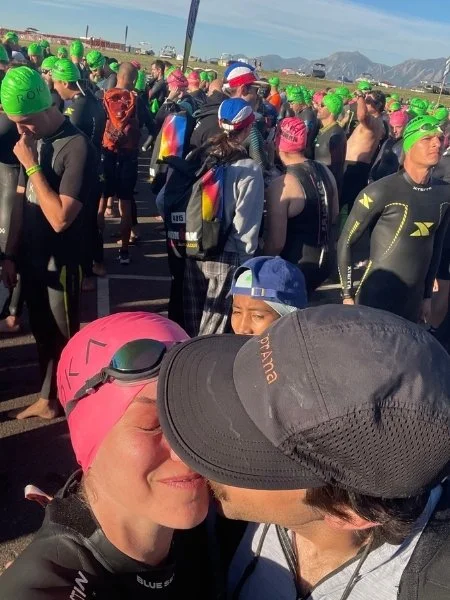
To be a pink cap in a sea of green. This is, by far, my favorite photo from race day. Women make up 25% of the Ironman 70.3 athletes and I’m proud to be one of those pink caps.
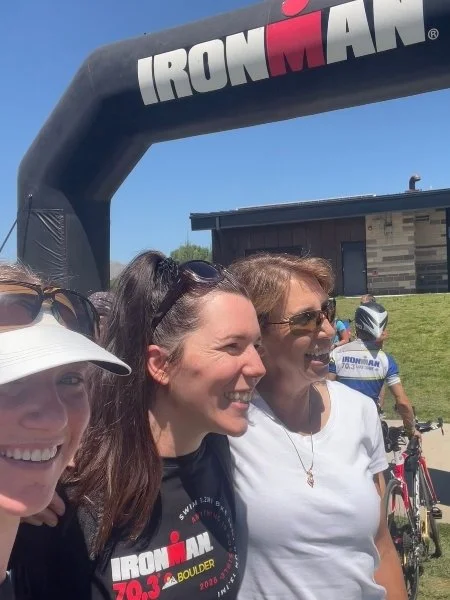
With Emily and Katie, two incredible women I met through Ironman, the day before the race.
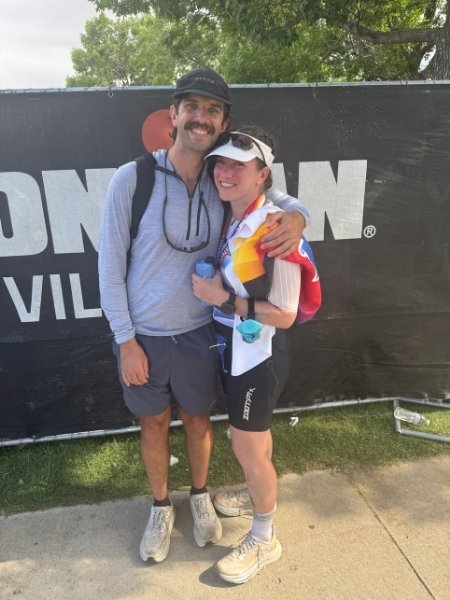
Celebrating post-race with Sam. Grateful for the person who encouraged me through every mile, every doubt, and all the way to the finish line.
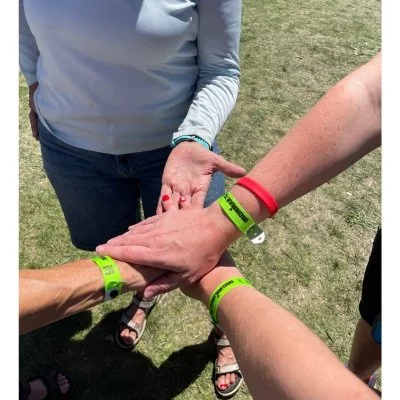
Four hands, one goal. Emily, Katie, and I about to take on our first Ironman 70.3 while Fran, a seasoned Ironman, cheered us on from start to finish.